Our use of cookies

We use necessary cookies to make our website work. We’d also like to use analytics and functional cookies which help us make improvements to the website by measuring how you use it, and to enable our website to offer you additional functionality.

More information on how we use cookies can be found in our cookie policy.

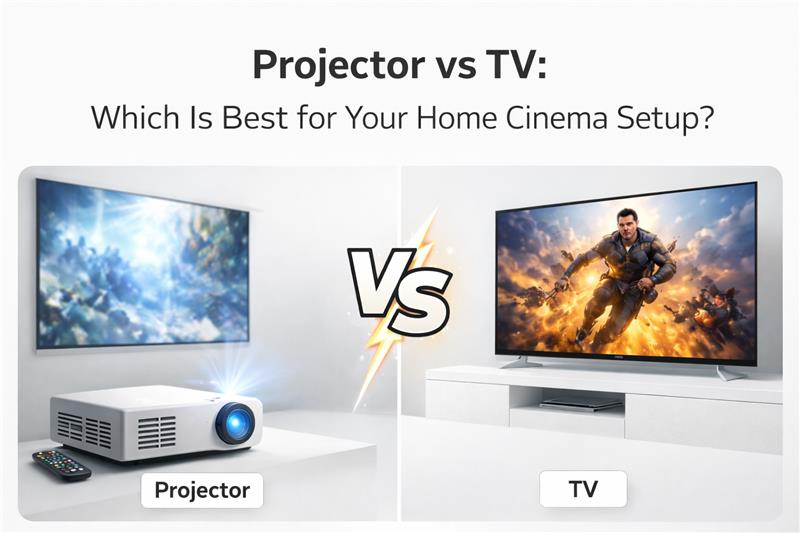
Projector vs TV: Which Is Best for Your Home Cinema Setup?

Projector vs TV: Which Is Best for Your Home Cinema Setup?

Projector vs TV: Which Is Best for Your Home Cinema Setup?

Projector vs TV

When you imagine your home cinema, it’s not just a bigger screen you’re after. It’s the feeling you get when the lights go down and the movie begins. You want immersion, not just pixels.

That’s why more home cinema builders in India are leaning toward projectors over TVs. The gap isn’t just about screen size — it’s about experience.

Why Projectors Are Winning the Home Cinema Conversation

Televisions have improved dramatically, but they still carry limits in scale. Even premium TVs max out under 100 inches, and beyond that, costs rise steeply.

A projector paired with a dedicated home projector screen can deliver truly large visuals — 120 inches, 150 inches, or even bigger — without the steep price jump. That extra size doesn’t just look bigger. It feels more cinematic.

Optoma’s 4K projectors aren’t just larger versions of traditional projectors. Many models use laser technology that delivers brighter, more consistent images over time. Laser light engines also have extraordinary durability, often rated for up to 30,000 hours of viewing without lamp replacements — that’s years of movies and games with minimal maintenance.

Advanced Visual Technology for True Cinema Feel

Projectors today are more than just “big TVs on walls.” They are designed for cinematic authenticity:

  • True 4K UHD resolution gives you four times the detail of Full HD, making films feel more lifelike and immersive.
  • Wide Colour Gamut modes ensure deeper, richer colours that bring movie visuals closer to what directors intended.
  • High contrast ratios make shadows deeper and highlights brighter — important for filmmakers who work with light and dark to tell stories.
  • PureMotion and motion interpolation technology smooth fast action, reducing blurring during sports and high-tempo scenes.

These advancements mean projection isn’t just “big.” It’s visually rich and dynamic, especially in a controlled cinema environment where lighting and screen choice enhance performance.

Gaming Everywhere: Projectors That Also Play

A modern home cinema is rarely used for movies alone. Many homeowners also want gaming, particularly with new consoles and PC setups. Projectors like the latest Optoma models include features that matter for gamers:

  • Enhanced Gaming Mode reduces input lag and optimises contrast and colours so games feel responsive and vivid.
  • High refresh rates (240Hz at 1080p) deliver smoother motion and responsiveness — useful for fast-paced gameplay.

Smart Home + Cinema: More Than Just Projection

Today’s projectors are connected devices. Many Optoma home cinema projectors come with built-in smart features:

  • Access to streaming and entertainment apps via integrated marketplaces.
  • Connectivity with voice assistants for hands-free control.
  • Tools like Creative Cast for sharing and streaming content easily from mobile devices.

How Optoma Approaches Home Cinema

Optoma has long focused on projection technology. Rather than treating projectors as a secondary product to TVs, they develop solutions that begin with cinematic performance in mind:

  • Laser projectors with long light source life and stable brightness.
  • True 4K UHD imaging with HDR and wide colour support.
  • Advanced gaming support with low lag and high refresh rates.
  • Easy installation tools like lens shift, keystone correction, and zoom adjustments for flexible home setups.

For Indian homeowners building serious cinema rooms, this combination of technology and service support makes projection not just an option — often the most compelling choice.

When a TV Still Makes Sense

Televisions are highly capable for:

  • Everyday TV viewing in bright rooms.
  • Spaces where a dedicated cinema environment isn’t feasible.
  • Quick, plug-and-play entertainment.

But if your priority is immersive cinematic scale, projectors clearly pull ahead.

The Verdict

A projector doesn’t just display content. It draws you into it. And when your goal is a real theatre experience at home, nothing replicates that feeling quite like the right projector and screen setup.

For a dedicated home cinema experience that delivers large screen sizes without prohibitive costs, rich cinematic visuals, and gaming performance without compromise, projectors are frequently the better choice.

FAQ|Common Questions

Q1: When does a TV still make sense?
Televisions are ideal for everyday viewing in bright rooms or spaces where a dedicated cinema environment isn’t feasible.
Q2: Are projectors high maintenance?
With modern laser technology, lamp replacements are a thing of the past. Many Optoma models offer up to 30,000 hours of life.
Q3: Can I use a projector in a room with windows?
Yes, by using a high-brightness projector and an ALR (Ambient Light Rejection) screen, you can enjoy clear images even during the day.
Q4: Is a projector good for gaming?
Absolutely. Modern projectors feature Enhanced Gaming Mode with low input lag and high refresh rates up to 240Hz.
Q5: How much space do I need for a 120-inch image?
This depends on the throw ratio. Short throw projectors can create a 120-inch image from just a few feet away.

Explore more insights at our Blog Center.